

Osmotic effects in tartaric acid pellet formulations: mechanisms, performance, and formulation relevance
Introduction on osmotic effects in tartaric acid pellet formulations
Osmotic effects in tartaric acid pellet formulations strongly influence water uptake, drug dissolution, and release control in multiparticulate dosage forms. In particular, osmotically active pellet cores create internal pressure gradients that drive fluid ingress and solute transport. As a result, formulation scientists can deliberately shape dissolution behavior by adjusting core composition and coating design. Moreover, acidic excipients such as tartaric acid not only generate osmotic forces but also control the microenvironmental pH. Consequently, these systems offer a powerful tool to improve the performance of poorly soluble drugs, especially weak bases that require localized acidification for optimal dissolution.
Osmolality in Pharmaceutical Formulations
Osmolality describes the concentration of osmotically active particles per kilogram of solvent. In pharmaceutical pellets, this property directly governs the extent of water penetration into the core. When osmolality inside the pellet exceeds that of the surrounding medium, water flows inward to equalize the gradient. Consequently, tartaric acid cores generate strong osmotic driving forces because the acid dissociates into multiple ions. Therefore, osmolality becomes a critical design parameter for predicting hydration, swelling, and internal pressure development in pellet formulations.
Effects on Dissolution Profiles and Osmotic Delivery
Osmotic effects strongly shape dissolution profiles by regulating fluid ingress and solute diffusion. As water enters the pellet core, it dissolves both the acid and the drug, which increases internal concentration and transport rates. Moreover, sustained osmotic pressure supports continuous water uptake over time. In tartaric acid pellet formulations, this process works synergistically with pH modulation. Consequently, weakly basic drugs experience improved solubility even in neutral or slightly alkaline environments. However, changes in external medium osmolality can reduce the gradient and slow release, which highlights the need for careful system optimization.
Obstacles and Opportunities for Acidic Formulations
Acidic pellet formulations present several formulation challenges. For example, premature leaching of tartaric acid can reduce both osmotic strength and pH control. Additionally, excessive water influx may weaken polymer coatings and compromise mechanical stability. Nevertheless, these challenges also create opportunities. By optimizing coating thickness and polymer selection, formulators can precisely time acid exposure and osmotic activation. Furthermore, acidic pellets enable targeted delivery to intestinal regions where conventional formulations fail. Therefore, tartaric acid pellets offer a versatile platform for advanced modified-release systems.
How tartaric acid starter cores affect the dissolution of albendazole
The referenced publication by K. Vlahovic, et al [1] examines how tartaric acid starter pellet cores affect the dissolution of albendazole, a poorly soluble weakly basic drug. The authors developed layered pellet systems in which albendazole was applied onto tartaric acid cores and subsequently coated with combinations of time-dependent and pH-dependent polymers. The study aimed to enhance drug release in intestinal pH conditions while preventing premature acid loss in the stomach.
First, the researchers compared tartaric acid pellets with inert sugar and microcrystalline cellulose cores. They observed that pellets containing tartaric acid significantly increased albendazole dissolution at pH 6.8. In contrast, inert cores failed to produce the same effect. Importantly, tartaric acid remained largely within the pellet core during dissolution testing, thereby maintaining an acidic microenvironment around the drug layer. As a result, albendazole solubility improved despite the higher external pH.
In addition, the authors measured osmolality to evaluate osmotic contributions. Tartaric acid pellet (TAP) solutions showed markedly higher osmolality than those prepared from inert cores. Therefore, the study linked enhanced water uptake and faster dissolution to stronger osmotic gradients. Furthermore, polymer coatings played a critical role. While time-dependent coatings delayed release, pH-dependent layers ensured acid exposure only at elevated pH values. Together, these mechanisms enabled precise control of both osmotic influx and microenvironmental pH.
Overall, the publication demonstrates that tartaric acid pellet cores function as active formulation components rather than inert carriers. By combining osmotic activity with localized acidification, the system significantly improved dissolution performance for a challenging drug candidate.
Osmotic effects in tartaric acid pellet formulations
Osmolality Study
The study determined the osmolality (Osmol/kg) of the various pellet core solutions using a previously established method. Among all tested cores, the tartaric acid pellet solution showed the highest osmolality at approximately 0.57 Osmol/kg, as illustrated in the figure below. In contrast, sugar sphere solutions reached only about one-third of the TAP osmolality. As expected, the water-insoluble microcrystalline cellulose (MCC) core produced an osmolality of zero. Thus, the higher osmolality of TAP suggests that it may influence in vitro release studies, in addition to the effect of microenvironmental pH [2].
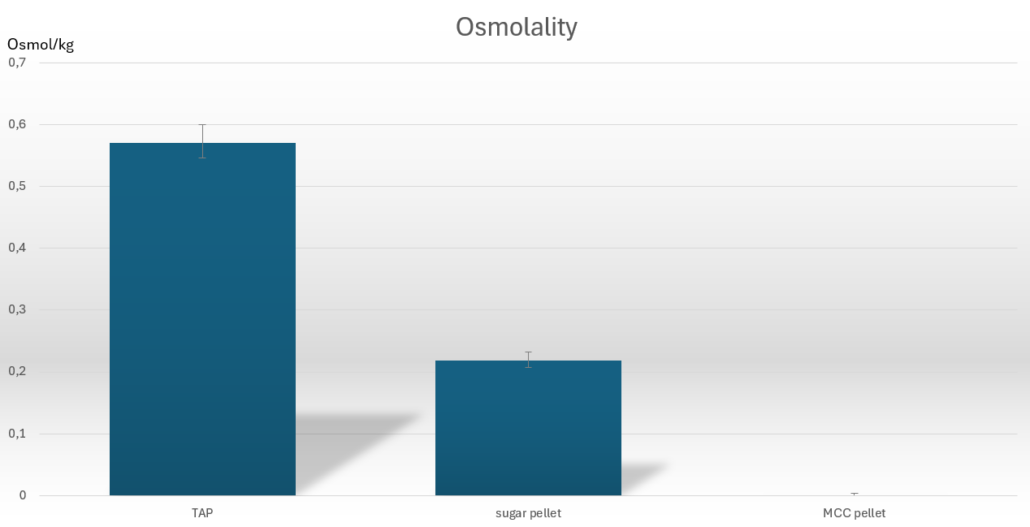
Osmolality of TAP, sugar, and MCC pellet core-type solutions, data from [2].
Conclusion and Outlook
Osmotic effects in tartaric acid pellet formulations provide a robust strategy to enhance dissolution and control drug release through combined osmotic and pH-driven mechanisms. The reviewed publication clearly shows that tartaric acid cores actively shape internal pellet conditions rather than serving as passive carriers. Looking ahead, further research should focus on fine-tuning osmotic strength, coating permeability, and acid retention. As a result, future pellet systems may achieve even greater precision in gastrointestinal targeting and therapeutic performance.
References
[1] K. Vlahovic, et al., Pharmaceutics 2025, 17(9), 1133; doi: 10.3390/pharmaceutics17091133
[2] N. Kállai-Szabó, et al., I. Review on starter pellets: Inert and functional cores. Pharmaceutics 2022, 14, 1299; doi: 10.3390/pharmaceutics14061299


 ingredientpharm
 linkedin
